
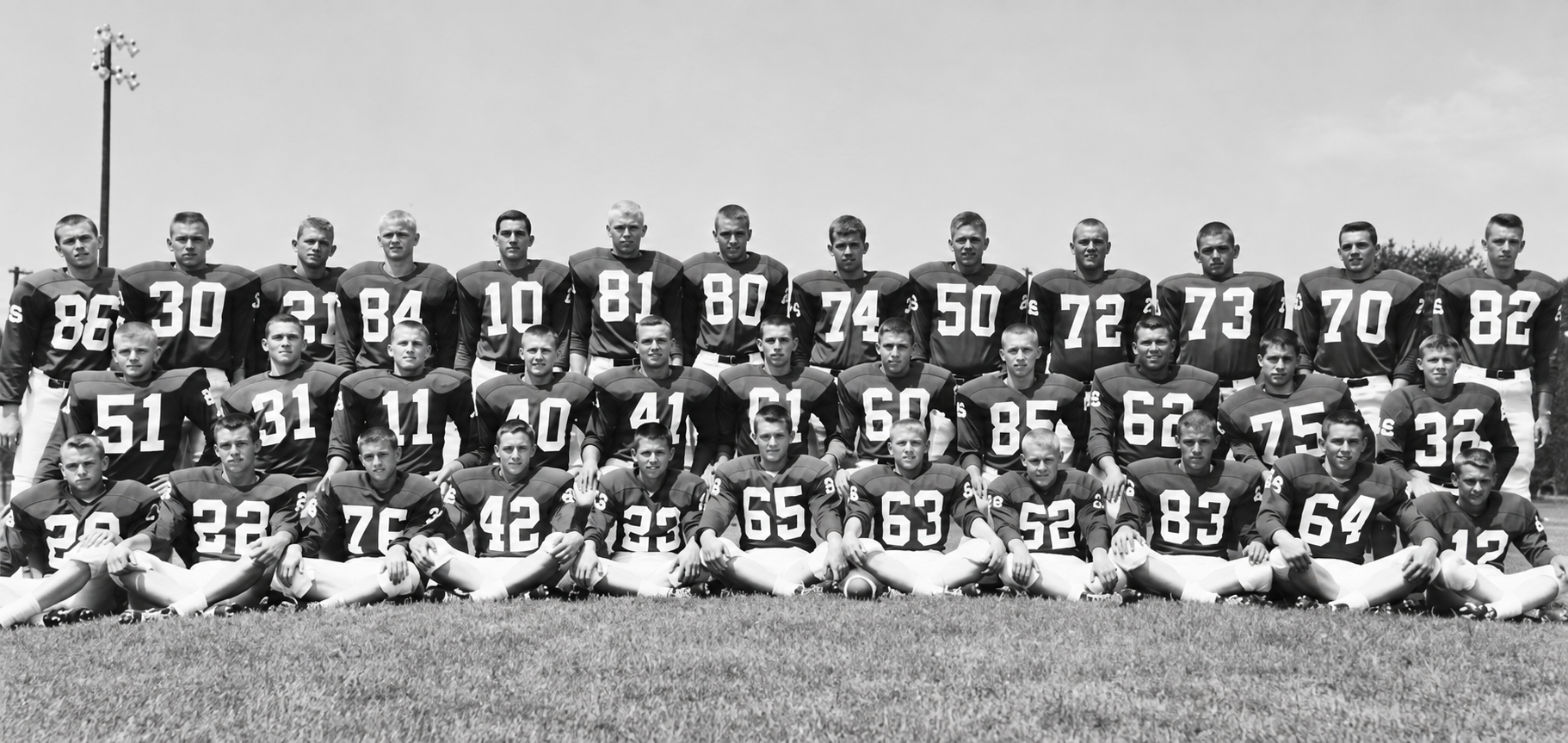
1982: The Season Corbin Survived Everything and Won the State Championship
Nobody looking strictly at Corbin’s regular season record in the fall of 1982 would have mistaken the Redhounds for an unstoppable football team. They lost four games, struggled early against some of the largest schools in Kentucky, were beaten decisively by Somerset late in the season and reached halftime of the district championship against Middlesboro trailing by 13 points. By then, frustration around the program had grown enough that some Corbin supporters were circulating a petition calling for the dismissal of head coach Larry “Cotton” Adams.
A few weeks later, those same Redhounds were state champions.
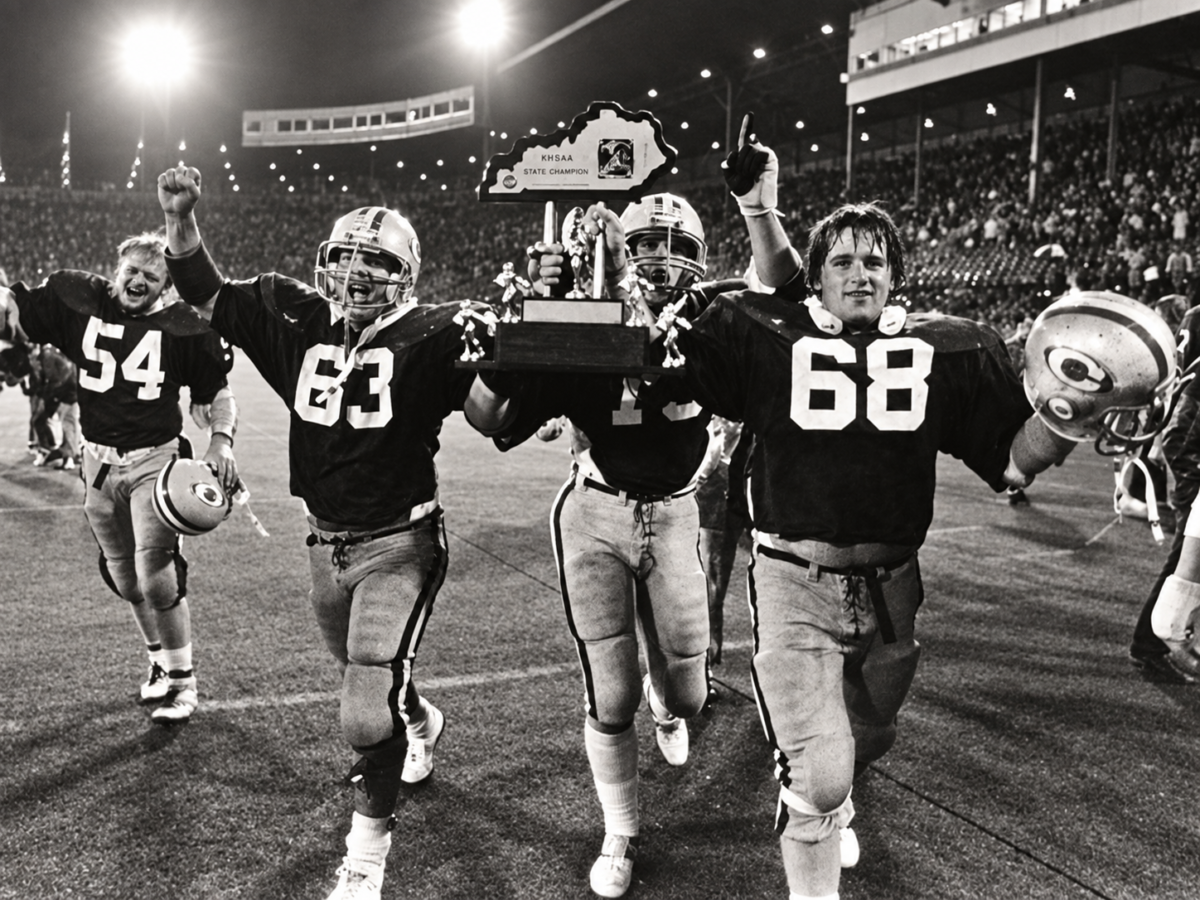
Corbin’s 1982 championship remains one of the more unusual title runs in Kentucky high school football history and one of the most compelling seasons the Redhounds ever produced. The team Adams later called the strangest of his coaching career survived a schedule intentionally loaded with difficult opponents, recovered from four regular season defeats and caught fire when the postseason arrived. Corbin eventually defeated Boyle County, 28 to 13, in the Class 2A regional championship and then beat Glasgow, 18 to 6, at Cardinal Stadium in Louisville to bring another state championship home.
The championship was Corbin’s third in seven seasons. Archie Powers had guided the Redhounds to titles in 1976 and 1980 before stepping away following the second championship, leaving the program to Adams, his longtime assistant and a former Corbin player. Adams had been part of the Redhounds’ 1962 state runner up team and had spent years coaching the offensive and defensive lines under Powers. When he became head coach, there was no question about the standard he inherited. Corbin had played for three state championships in five seasons under Powers, winning two of them, and anything less than another deep postseason run was going to be measured against what had just come before.
The 1982 schedule gave Adams little opportunity to ease his team into the season. Corbin had difficulty finding enough opponents and filled the openings with teams few Class 2A programs would have willingly selected. Adams later referred to the schedule as a “murderer’s row,” and the Redhounds began the season against Class 4A powers Madison Central and Bryan Station. Corbin lost both games. Those defeats immediately placed a new head coach and a young team under pressure, but they also exposed the Redhounds to the kind of size and physical football they would not regularly encounter within their own classification.
The roster was not short on talent. Steve Jewell, who had been part of the 1980 championship team and would later return to Corbin as head coach, played linebacker on the 1982 club. Tommy Greer was one of the team’s most gifted athletes and later signed with Western Kentucky. Greg Duncum became an important part of the backfield and conversion game, while Steve Rawlings emerged as another runner who would play a decisive role in the championship game. Harold Rudy handled kicking duties and eventually supplied the first points of the state final. The team was young enough that several of the key players returned the following season, one reason longtime Corbin followers have remembered the 1983 team as another exceptionally talented group.
The early losses to Madison Central and Bryan Station were not the end of Corbin’s difficult regular season. Danville beat the Redhounds as well, giving Adams another loss against an established central Kentucky program. The setbacks were frustrating inside a program accustomed to winning, but Adams maintained that the schedule was doing exactly what he hoped difficult competition would do. Corbin was being forced to play faster and more physically than it would have against a softer schedule, and the coach believed that would matter once district play arrived.
Somerset provided perhaps the clearest example of how demanding the season had become. The Briar Jumpers had one of their strongest teams of the era and went to Corbin late in the season and defeated the eventual state champions, 20 to 6. Somerset had enough talent to be considered one of the best teams in Class 2A, but the postseason system of the time allowed only a limited number of district qualifiers. A 28 to 27 district loss to Boyle County eventually kept Somerset out of the playoffs despite its victory over Corbin. Years later, longtime followers of the program still regarded the 1982 Somerset team as one of the best teams in school history never to play for a state championship.
The Somerset loss left Corbin with four defeats, the others coming against Madison Central, Bryan Station and Danville. For a Redhound program accustomed to championship expectations, the record was difficult to accept. The fact that the losses came against strong competition did not eliminate the criticism. Adams was in only his second season as Corbin’s head coach, and comparisons with Powers were inevitable.
That pressure reached its highest point when Corbin faced Middlesboro with the district championship at stake. The Yellow Jackets had been one of the Redhounds’ traditional rivals for decades, and this was no ordinary regular season game. The winner would continue toward the postseason. The loser would have an entire winter to think about it.
Middlesboro controlled the first half.
When the teams went to the locker room, Corbin trailed 21 to 8.
Adams later recalled seeing people in the stands circulating a petition calling for him to be fired. He eventually joked that even his wife had almost signed it, but there was nothing funny about the situation at the time. The defending program tradition, the season and perhaps Adams’ future in Corbin were all sitting on the same halftime scoreboard.
The second half became the turning point of the entire season.
Adams later called it the greatest half of football he ever saw one of his Corbin teams play. The Redhounds came out of the locker room and erased the 13 point deficit, taking control of the game and defeating Middlesboro to capture the district championship. Adams remembered that once Corbin survived Middlesboro, the personality of the team changed. The Redhounds were no longer merely surviving a difficult schedule. They began playing like a team that expected to win.
Jewell remembered the intensity surrounding that Middlesboro game years later. Adams was not simply coaching from the sideline. Jewell recalled seeing him standing near the back of the bleachers waving his hat and trying to bring the crowd into the game. It was typical of the coach his players knew. Adams demanded perfection and could be relentless, but Jewell also described him as the team’s biggest cheerleader. The relationship between Adams and his players became particularly important during a season when the team had already absorbed four losses and endured weeks of outside doubt.
The Middlesboro comeback changed Corbin’s season. Adams later said that every team the Redhounds faced after getting past the Yellow Jackets was dominated by a Corbin team that had finally come together at the right time. The losses to Madison Central, Bryan Station, Danville and Somerset had not disappeared from the record, but the experience gained in those games suddenly became useful. Corbin had played larger teams, faster teams and teams good enough to expose weaknesses. By the time the games became elimination games, the Redhounds were prepared for them.
The next major obstacle was Boyle County.
The Rebels had put together an 8 and 2 regular season and had won the district championship under coach Ed Rall. Boyle’s schedule included a dramatic 28 to 27 victory over Somerset, the same Somerset team that had beaten Corbin, 20 to 6. That one point victory was crucial because it sent Boyle County into the postseason while leaving Somerset at home. Boyle also beat Marion County, Harrodsburg, Mercer County, Wayne County, Russell County, Lincoln County and Garrard County during the season.
That set up the Class 2A regional championship at Corbin.
The matchup provided a useful comparison. Somerset had beaten Corbin. Boyle County had beaten Somerset. None of it mattered when the teams actually took the field.
Corbin beat Boyle County, 28 to 13.
The Redhounds controlled the regional final and ended Boyle’s season at 8 and 3, moving another step closer to Louisville. Historical records of the Corbin and Boyle County series still list the 1982 regional final as the second meeting between the programs, following Corbin’s 37 to 15 postseason victory over the Rebels in 1977.
For Corbin, the 28 points against Boyle were another indication that the team Adams had been trying to develop all season had finally arrived. The Redhounds were not merely protecting narrow leads and hoping to survive. They were beginning to impose themselves physically on playoff opponents, exactly as Adams had predicted when he said the difficult regular season would prepare his players for district and postseason football.
The players who carried Corbin through the run reflected the physical nature of the team. Jewell provided toughness at linebacker and represented a direct connection to the 1980 championship team. Greer’s athletic ability allowed him to contribute in several ways and eventually earned him an opportunity at Western Kentucky. WKU’s later media guide described Greer as a multi sport standout at Corbin who earned All State honorable mention recognition and played his high school football for Adams. Duncum provided another physical presence, while Rawlings gave Corbin a runner capable of finishing drives.
By the time Corbin reached the state championship game, the early season narrative had been completely reversed. The team that once appeared too inconsistent to survive its own schedule had become the last eastern Kentucky team standing in Class 2A.
Glasgow was waiting in Louisville.
The Scotties were coached by Coy Meadows and had put together their own championship run through western Kentucky. Glasgow had eliminated Mayfield, 6 to 0, in the postseason, stopping a Cardinals program that had been a regular fixture in the Class 2A championship race throughout the previous decade. Mayfield’s own playoff records show that its 1982 team finished 10 and 3 after beating Fort Campbell, 24 to 14, and then losing the 6 to 0 decision at Glasgow.
The Class 2A state championship was played at Cardinal Stadium in Louisville before an announced crowd of 1,700.
For three quarters, neither team scored.
Corbin and Glasgow spent the first quarter trading field position without finding the end zone. The second quarter ended the same way, sending the teams to halftime tied at 0. The defenses remained in control through the third quarter, and after 36 minutes of championship football, there was still no score.
The fourth quarter changed everything.
Harold Rudy finally broke the scoreless tie with a 21 yard field goal, giving Corbin a 3 to 0 lead. In a game where points had been impossible to find, Rudy’s kick immediately changed the pressure on Glasgow. The Scotties could no longer simply wait for one big play. They now had to answer a Corbin team whose defense had already kept them out of the end zone for three quarters.
Greer followed with the first touchdown of the championship game, scoring on a 5 yard run. The official KHSAA championship summary incorrectly lists him as “Timmy Greer,” but Western Kentucky’s records and Corbin’s own history establish the player as Tommy Greer. Duncum ran in the conversion, and Corbin had finally created some separation.
Rawlings then scored from a yard out to extend the lead. The Redhounds had gone three quarters without scoring and then produced a field goal and two rushing touchdowns in the fourth. Glasgow finally reached the end zone on a 3 yard run by Todd Childress, but the conversion attempt failed and the Scotties never threatened Corbin’s control of the game again.
The final score was Corbin 18, Glasgow 6.
The Redhounds were state champions.
The championship gave Adams something he had pursued in virtually every role possible at Corbin. He had watched great Redhound teams as a boy, played for a state championship as a teenager, helped coach championship teams as an assistant and now had won one as the head coach. The achievement also confirmed that Corbin’s success had not ended when Powers stepped away after the 1980 title. The program had survived a coaching transition and remained among the best in Class 2A.
The players carried that continuity as well. Jewell had been part of both the 1980 and 1982 championship teams and would eventually return to lead Corbin as head coach. Greer went on to Western Kentucky before beginning his own coaching career and later returned to Corbin, where he also served as head coach. Duncum remained tied to the program and eventually became part of later Corbin coaching staffs. The 1982 team was not simply a collection of players who disappeared after graduation. Several of the men involved became part of the bridge between different generations of Redhound football.
Looking back, the regular season losses are what make the championship more interesting rather than less impressive. Corbin lost to Madison Central and Bryan Station to open the season against Class 4A competition. Danville beat the Redhounds. Somerset came to Corbin and won, 20 to 6. Four defeats created questions about the team and about Adams. By the time Middlesboro led 21 to 8 at halftime, there was little evidence on the scoreboard that a state championship was coming.
Then the season turned.
Corbin came back against Middlesboro and won the district championship. The Redhounds beat an 8 win Boyle County team, 28 to 13, in the regional final. They advanced to Louisville, played Glasgow scoreless for three quarters and then scored 18 points in the fourth quarter to win the state championship.
That was the 1982 season in full.
It was not clean, and it was not perfect. The Redhounds did not need it to be.
The difficult schedule Adams had once struggled to fill ultimately produced exactly the kind of team he hoped it would create. Corbin had already experienced losing, already faced larger opponents and already been pushed to the point where a season appeared ready to collapse. When the postseason arrived, there was very little left that could frighten them.
The final result became one of the most enduring numbers in Corbin football history.
Corbin 18, Glasgow 6.
The Redhounds had lost four games.
They were also state champions.
12 games
- 20 Fri Aug at Madison Central Away L 0-8
-
27
Fri Aug
 vs Bryan Station
Home·Campbell Field
L
6-26
vs Bryan Station
Home·Campbell Field
L
6-26
-
10
Fri Sep
 vs Whitley County
Home·Campbell Field
W
37-0
vs Whitley County
Home·Campbell Field
W
37-0
- 17 Fri Sep vs Glasgow Home·Campbell Field W 20-12
- 24 Fri Sep at Danville Away·Admiral Stadium L 7-10
- 1 Fri Oct at Cawood Away W 29-8
- 8 Fri Oct vs Evarts Home·Campbell Field W 26-0
-
15
Fri Oct
 vs Somerset
Home·Campbell Field
L
6-20
vs Somerset
Home·Campbell Field
L
6-20
-
29
Fri Oct
 at Middlesboro
Away·Bradner Stadium
W
22-21
at Middlesboro
Away·Bradner Stadium
W
22-21
-
12
Fri Nov
 vs Boyle County
Home·Campbell Field ·KHSAA Playoffs
W
28-13
vs Boyle County
Home·Campbell Field ·KHSAA Playoffs
W
28-13
- 19 Fri Nov at Prestonsburg Away ·KHSAA Playoffs W 28-0
- 26 Fri Nov vs Glasgow Neutral·Cardinal Stadium ·KHSAA State Championship W 18-6
Notes. Only the state final is documented so far. Regular-season results, roster and record still to be researched.
Source KHSAA, KHSAA football state championship history (past winners), Verified September 7, 2026 View source Head coach, opponent, score and site from the KHSAA state championship history.