
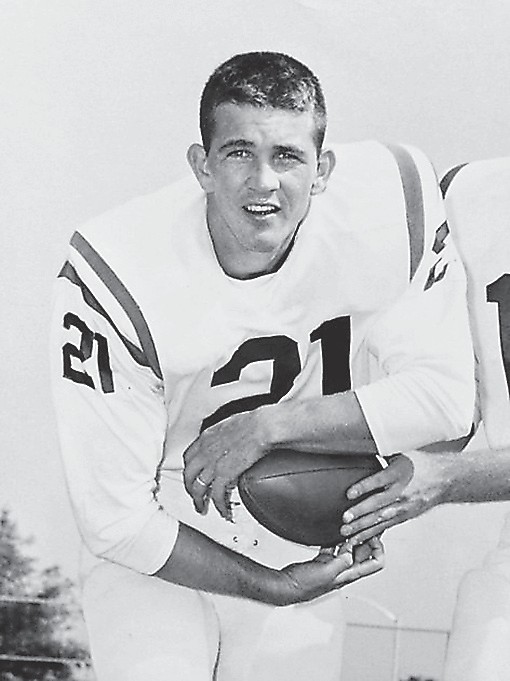
Calvin Bird
Before the state championships became trophies, before Kentucky high school football had the playoff system generations of fans now know, and long before Friday-night highlights could turn a teenager into an overnight sensation, Corbin had Calvin Bird.
There are great football players whose accomplishments survive in record books. There are others whose reputations are passed from one generation to the next, their stories growing into part of a town’s identity.
James Calvin Bird became both.
For two seasons in the mid-1950s, Bird established himself as one of the most celebrated high school football players in Kentucky. He was a two-time All-State selection, a two-time high school All-American, led Corbin to its legendary undefeated 1955 championship season and followed it by scoring 264 points in 1956 — then a Kentucky single-season record.
The Kentucky High School Athletic Association would eventually describe him by a nickname that seems almost understated considering what he accomplished:
“The Magnificent Running Machine.”
For Corbin, however, Calvin Bird became something more.
He became one of the players who helped establish what it meant to be a Redhound.
A Football Family in a Football Town
Born February 11, 1938, Bird grew up during an extraordinary period in Corbin athletics.
The Bird family became synonymous with athletic excellence in southeastern Kentucky. Jerry, Calvin, Billy and Rodger Bird would all eventually compete at the University of Kentucky, an almost unimaginable achievement for four brothers from the same small Kentucky town.
Jerry became a basketball standout at UK. Calvin, Billy and Rodger played football for the Wildcats. Jerry, Calvin and Rodger would eventually have their Kentucky jerseys retired.
But before Lexington, there was Corbin.
And during the fall of 1955, Calvin Bird helped produce one of the defining seasons in Redhound football history.
Corbin had already established a football tradition, including its celebrated 1939 team. But the 1955 Redhounds added another chapter, going unbeaten and claiming what is recognized historically as a mythical state championship in the era before Kentucky’s modern postseason playoff structure.
Bird was the star.
He was fast, powerful and remarkably versatile. More than half a century later, people who saw him play could still remember individual moments.
Larry “Cotton” Adams was nine years old when he attended a Corbin game in 1955. Adams would eventually become a Redhound player, assistant coach and state-championship head coach himself, but one of his earliest memories of Corbin football involved Bird.
Adams remembered Bird taking the opening kickoff all the way for a touchdown — and hurdling a defender around midfield in the process.
“It was something,” Adams later told KHSAA historian Mike Fields.
For a nine-year-old sitting in the stands, it was unforgettable.
For Corbin, performances like it were becoming almost expected.
The 1955 Redhounds
Bird’s junior season became part of Corbin football folklore.
The Redhounds rolled through 1955 without a loss, and Bird emerged as one of Kentucky’s premier high school players. He earned All-State recognition and high school All-America honors while helping Corbin claim the championship.
The season also included an appearance in the Recreation Bowl, one of Kentucky’s most prestigious high school football events of the era. Corbin defeated Newport 27-7 in the 1955 game.
There was no KHSAA playoff bracket to navigate in those days. Kentucky did not yet determine its football champions through the postseason system that would arrive later.
Championships were instead determined through rankings and reputation.
And in 1955, Corbin stood at the top.
For generations of Redhound fans, the distinction between a “mythical” championship and a modern playoff championship has done little to diminish what that team represents. KHSAA itself includes 1955 among Corbin’s championship seasons alongside 1939, 1976, 1980 and 1982.
Calvin Bird was at the center of it.
Then came 1956.
And somehow, he became even better.
264 Points
Bird’s senior season produced one of the extraordinary offensive performances in Kentucky high school football history.
He scored 264 points.
At the time, it established a Kentucky single-season scoring record. KHSAA’s Hall of Fame biography specifically cites the 264-point season as one of the defining accomplishments of Bird’s career.
To understand that number, consider what 264 points means.
That’s the equivalent of 44 touchdowns if every point had come from touchdowns alone.
And Bird played in the 1950s.
There were no spread offenses designed to manufacture dozens of touches for one player. There were no 15-game state-championship seasons. There was no modern strength-and-conditioning infrastructure or year-round specialization.
Yet week after week, Bird scored.
The final points of that historic season came in the Recreation Bowl.
Corbin faced Dixie Heights before a crowd reported at approximately 6,000. Dixie Heights won the game 26-7, but Bird accounted for Corbin’s lone touchdown. Those six points pushed his season total to 264.
Decades later, that number still appears among the greatest single-season scoring totals in Kentucky football history.
Bird had now been named All-State in consecutive seasons.
He had been named a high school All-American in consecutive seasons.
He had helped lead Corbin to an undefeated championship.
And he had established a Kentucky scoring record.
His high school career was finished.
His football career wasn’t.
From Corbin to Kentucky
Bird remained home-state royalty when he traveled north to Lexington and joined the University of Kentucky football program.
Playing for head coach Blanton Collier from 1958 through 1960, Bird demonstrated the same versatility that had made him so dangerous at Corbin.
Kentucky used him as a running back.
And a receiver.
And a defensive back.
And a kickoff returner.
And a punt returner.
UK Athletics later described Bird as one of the most versatile players in Wildcats history.
He made an immediate impact.
As a sophomore in 1958, Bird led the Southeastern Conference in receiving and was named SEC Sophomore of the Year. UK records show him catching 21 passes for 373 yards and four touchdowns that season, an average of 17.8 yards per reception.
He wasn’t a one-year wonder.
Bird earned second-team All-SEC recognition in 1959 and first-team All-SEC honors as a senior in 1960. He led Kentucky in receiving and all-purpose yardage in each of his three varsity seasons.
And if there was one opponent that brought out the best in the former Redhound, it was Tennessee.
Bird’s performances against the Volunteers became part of his Kentucky legacy. One of the most memorable came in 1959, when Kentucky shut out Tennessee 20-0. Bird scored three touchdowns, including a 63-yard punt return, accounting for 18 of Kentucky’s 20 points.
For a kid from Corbin who had once electrified crowds at home with kickoff returns, the stage had simply gotten bigger.
The result looked remarkably familiar.
No. 21
After his senior season at Kentucky, Bird participated in three postseason all-star games and was named the most valuable back in the All-American Bowl.
Professional football followed.
Bird was selected in the 17th round of the 1961 NFL Draft and also in the sixth round of the AFL Draft. He later spent time with the New York Jets organization.
But his accomplishments at Kentucky ultimately became a permanent part of the university’s football history.
In 1997, Kentucky officially retired Calvin Bird’s No. 21 jersey.
At the time, UK cited his extraordinary versatility, SEC honors, return ability and all-purpose production as reasons for the honor.
Think about that for a moment.
A kid from Corbin, Kentucky, left home after becoming one of the greatest high school players in the state’s history and eventually had his number retired by the University of Kentucky.
And he wasn’t even the only Bird brother to receive that honor.
Jerry’s basketball jersey was retired.
Rodger’s football jersey was retired.
Three brothers from Corbin ultimately had their numbers hanging among Kentucky’s greats.
It remains one of the remarkable family stories in Kentucky sports history.
“He Wanted the Ball”
Statistics can explain part of Calvin Bird’s greatness.
They can’t completely explain why people in Corbin continued talking about him more than half a century after he played his final game for the Redhounds.
When Bird died in June 2013 at age 75, hundreds gathered in Corbin to remember him.
Henry Martin, a Corbin High graduate and former member of the school board, described Bird as an athlete whose reputation spread far beyond his hometown.
Martin remembered the physical gifts — the speed, size and agility.
But what separated Bird, he said, was something else.
When the game was on the line, Bird wanted responsibility.
“He wanted the ball,” Martin remembered. “He would carry it every time.”
Perhaps that is the best description of Calvin Bird the football player.
Give him the ball.
On offense.
On a kickoff.
On a punt.
When Corbin needed a touchdown.
When Kentucky needed a play.
Give Calvin Bird the football and see what happened.
A Redhound Forever
Corbin has produced extraordinary athletes across generations.
There have been state champions, All-State selections, college stars and professional athletes. The Redhound football program has celebrated championship teams from multiple eras and sent generations of players on to college football.
But Calvin Bird occupies a special place in that history.
He represents an era when a small southeastern Kentucky town somehow became one of the richest sources of athletic talent in the Commonwealth.
He represents the 1955 Redhounds, an undefeated team that remains one of the foundational teams in Corbin football history.
He represents a family whose athletic accomplishments may never be duplicated.
And he represents numbers that still sound almost fictional seven decades later:
264 points in one season.
Two-time All-State.
Two-time high school All-American.
1955 undefeated state champion.
SEC Sophomore of the Year.
All-SEC.
University of Kentucky No. 21 retired.
Corbin eventually retired Bird’s football number as well.
That was fitting.
Because there are players who have great seasons.
There are players who set records.
And then there are players who become part of the identity of the place where they grew up.
Calvin Bird became that for Corbin.
Long after the touchdowns, long after the records and long after the final whistle, people still remembered the kid who could take a kickoff, find daylight and disappear.
Cotton Adams certainly did.
More than six decades after that afternoon in 1955, he could still picture Bird crossing midfield and hurdling a defender on his way to the end zone.
That is what a legend looks like.
Calvin Bird wasn’t simply one of the greatest players to wear a Corbin uniform. He was one of the players who helped make wearing that uniform mean something.